
Alexandria
QUICK FACTS AT A GLANCE
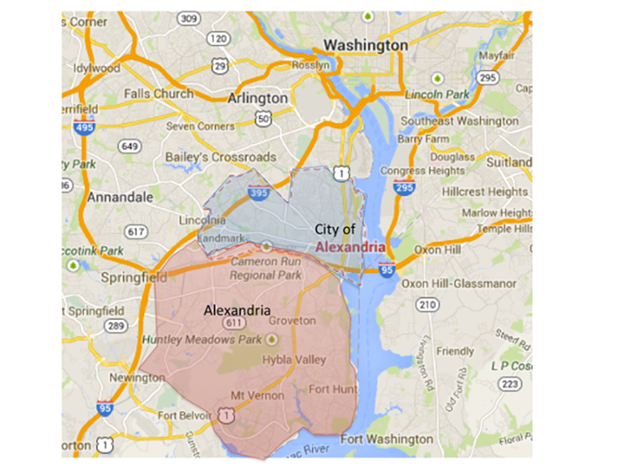
Jurisdiction Type: The City of Alexandria is an independent city separate from Fairfax County. However, some homes with an Alexandria mailing address are actually located in Fairfax County. Because schools, taxes, and local government services differ between the City of Alexandria and Fairfax County, it is important to verify a property's jurisdiction when buying a home in the Alexandria area.
Population: ~159,100 residents (2024 est.); population density approximately 10,483 people per square mile
Land Area: ~15.5 square miles (City of Alexandria)
ZIP Codes: Alexandria ZIP codes can be confusing because postal boundaries do not always align with city and county boundaries. While ZIP codes such as 22301, 22302, 22304, 22305, and 22314 are primarily associated with the City of Alexandria, other Alexandria ZIP codes—including 22303, 22306, 22307, 22308, 22309, 22310, and 22315—are generally located in Fairfax County despite carrying an Alexandria mailing address. Some ZIP codes, including 22311 and 22312, span both jurisdictions, making it important to verify a property's actual location rather than relying solely on its mailing address.
Adjacent Jurisdictions: Arlington County (north), Fairfax County (west and south), Washington, D.C. (across the Potomac River)
Distance to Washington, D.C.: ~5–7 miles south of downtown Washington, D.C.
Metro & Rail Access: Served by WMATA Blue & Yellow Lines; stations include King St–Old Town, Braddock Road, Potomac Yard, Eisenhower Avenue, and Van Dorn Street. VRE Manassas and Fredericksburg Lines serve Alexandria Station
Avg. Metro Commute to D.C.: ~20–25 minutes to downtown Washington via Metro
Key Roads & Highways: I-395, I-495 Capital Beltway, George Washington Memorial Parkway, Route 1 (Richmond Highway), Duke Street (Route 236)
School Systems: Alexandria City Public Schools (ACPS) within city limits; Fairfax County Public Schools (FCPS) for Fairfax County portions of overlapping ZIP codes
Founded / Incorporated: Founded in 1749; retroceded from the District of Columbia to Virginia in 1846; incorporated as an independent city in 1852
Walk Score®: Old Town and Del Ray ~90+ (Walker’s Paradise); West End ~50–65 (Somewhat Walkable); citywide average ~67–72 (Somewhat Walkable)
OVERVIEW & GEOGRAPHY
Alexandria, Virginia is an independent city on the western bank of the Potomac River, approximately five to seven miles south of downtown Washington, D.C. It covers 15.2 square miles of entirely urban land — one of the most densely populated jurisdictions in Virginia — and is bounded on the north by Arlington County (along the natural boundary of Four Mile Run), on the west and south by Fairfax County, and on the east by the Potomac River, which separates it from Maryland. While Alexandria is a distinct jurisdiction separate from Fairfax County, buyers should note that some nearby Fairfax County communities also carry Alexandria mailing addresses. As a result, an "Alexandria, VA" address does not necessarily indicate that a property is located within the City of Alexandria, making it important to verify the property's actual jurisdiction, schools, taxes, and local government services.
Alexandria City is organized around several primary corridors. King Street runs east–west from the Potomac waterfront to I-395, serving as Alexandria’s historic main street for dining, retail, and cultural institutions. U.S. Route 1 (Jefferson Davis Highway) runs north–south through the city, connecting it to Arlington County and the National Landing area to the north and to Fairfax County to the south. Eisenhower Avenue bisects the city’s interior, forming the spine of the Carlyle business district. Duke Street (Virginia State Route 236) connects the historic core to the West End. The George Washington Memorial Parkway — a National Park Service scenic road — traces the Potomac riverfront northward through Old Town into Arlington. Interstate highways I-95, I-495 (the Capital Beltway), and I-395 provide regional highway access; the Beltway forms Alexandria’s southern boundary and I-395 its western edge.
Alexandria was formally established in 1749 by Scottish merchants on land first surveyed in part by a teenage George Washington. The city was incorporated under Virginia law in 1852 as an independent city, a legal designation unique to Virginia that means Alexandria functions outside any county structure entirely. From 1791 to 1846, portions of Alexandria were part of the original District of Columbia before being retroceded to Virginia — a fact that shapes the street grid of Old Town to this day. The former independent town of Potomac (the area now called Del Ray and adjacent neighborhoods) was annexed by Alexandria in 1930, significantly expanding the city’s residential footprint to the northwest.
For planning purposes, Alexandria divides into named Small Area Plan zones: Old Town and Old Town North; Del Ray and Arlandria; Eisenhower East / Carlyle and Eisenhower West; Potomac Yard; Seminary Hill; North Ridge; and the West End. Each carries distinct density, price range, transit access, and development trajectory — distinctions that matter significantly for buyers and long-term investors. Buyers should also be aware that many popular communities with Alexandria mailing addresses, including Belle Haven, Fort Hunt, Mount Vernon, Franconia, Kingstowne, and parts of Groveton, are actually located in Fairfax County rather than within the City of Alexandria, with their own schools, taxes, and local government services.
Key NEIGHBORHOODS & COMMUNITIES
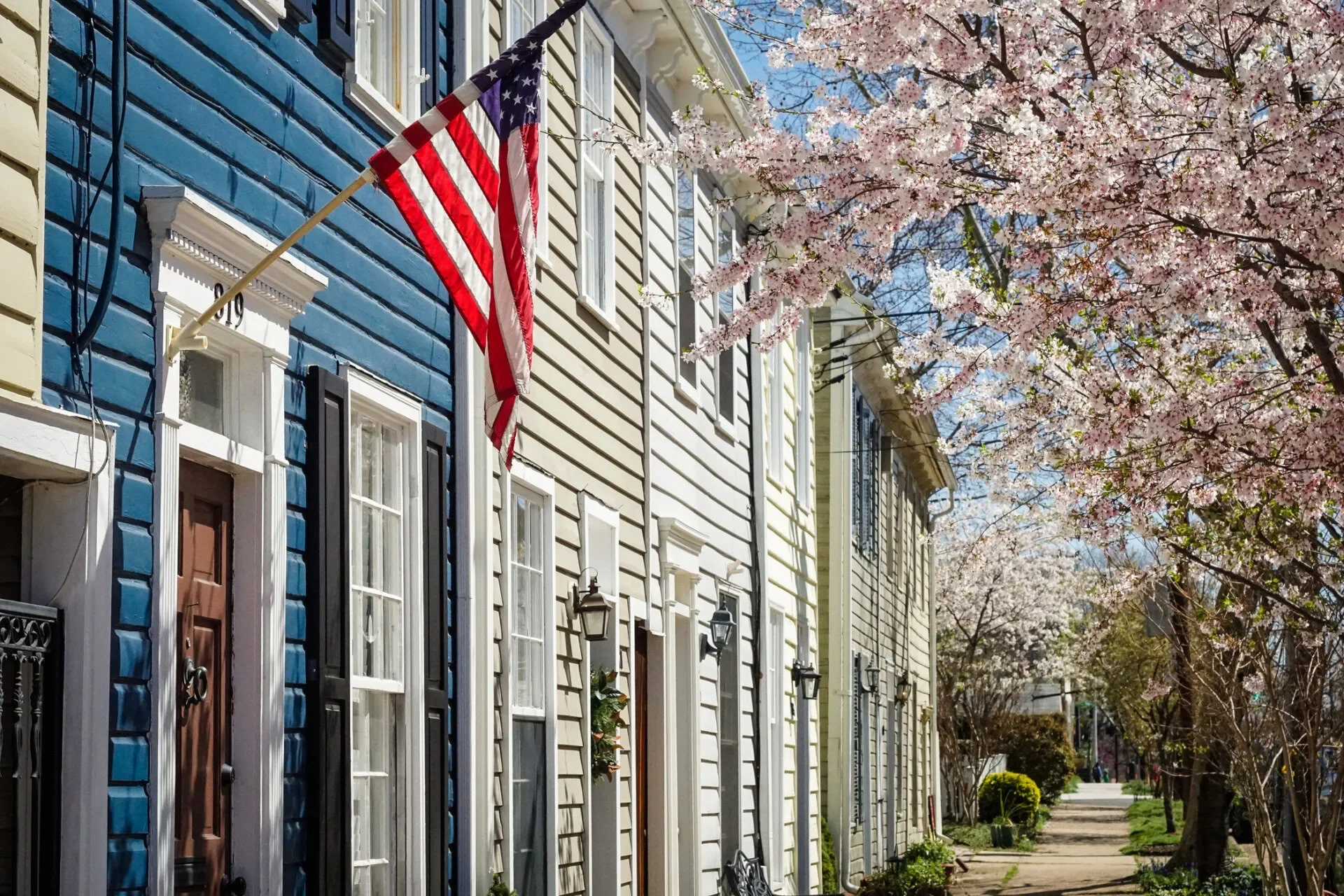
Alexandria’s neighborhoods span the full spectrum from 18th-century cobblestone to brand-new transit-oriented development. The descriptions below are organized by submarket, with approximate 2025 pricing where available.
Old Town ALexandria — Old Town Alexandria is one of the most beloved neighborhoods in Northern Virginia. It sits along the Potomac River, just minutes from Washington, DC. The neighborhood is known for its brick sidewalks, historic homes, waterfront parks, shops, restaurants, and easy Metro access.
Rosemont — Rosemont is one of Alexandria's most charming and established neighborhoods. Located just west of Old Town and immediately adjacent to the King Street–Old Town Metrorail Station area, Rosemont combines historic character, walkability, beautiful tree-lined streets, and exceptional commuter convenience.
Beverly Hills — Beverley Hills is one of Alexandria’s most charming residential neighborhoods. It sits in northern Alexandria, above Del Ray and Rosemont, with rolling streets, mature trees, classic homes, and a quiet, tucked-away feel. Many homes here were built in the 1930s and 1940s.
North Ridge — North Ridge is one of Alexandria’s most loved residential neighborhoods. It sits in the north end of the city, close to Del Ray, Old Town, Rosemont, Shirlington, and Washington, DC. The neighborhood is known for quiet streets, mature trees, classic homes, and a strong community feel.
Del Ray — Del Ray is one of the most beloved neighborhoods in Alexandria. Located just north of Old Town and minutes from Washington, DC, Del Ray combines small-town charm with urban convenience. Its heart is Mount Vernon Avenue, a walkable main street lined with locally owned restaurants, coffee shops, boutiques, fitness studios, and community gathering spaces.
Seminary Hill — Nestled in Alexandria's West End, Seminary Hill is one of the city's most convenient and surprisingly scenic neighborhoods. Named after the historic Virginia Theological Seminary, the area sits on one of the highest elevations in Alexandria, offering beautiful views, mature trees, and easy access to Washington, DC.
TRANSIT, COMMUTE & WALKABILITY
Metro Rail (WMATA)
Alexandria is served by five Metrorail stations on the Blue Line and Yellow Line:
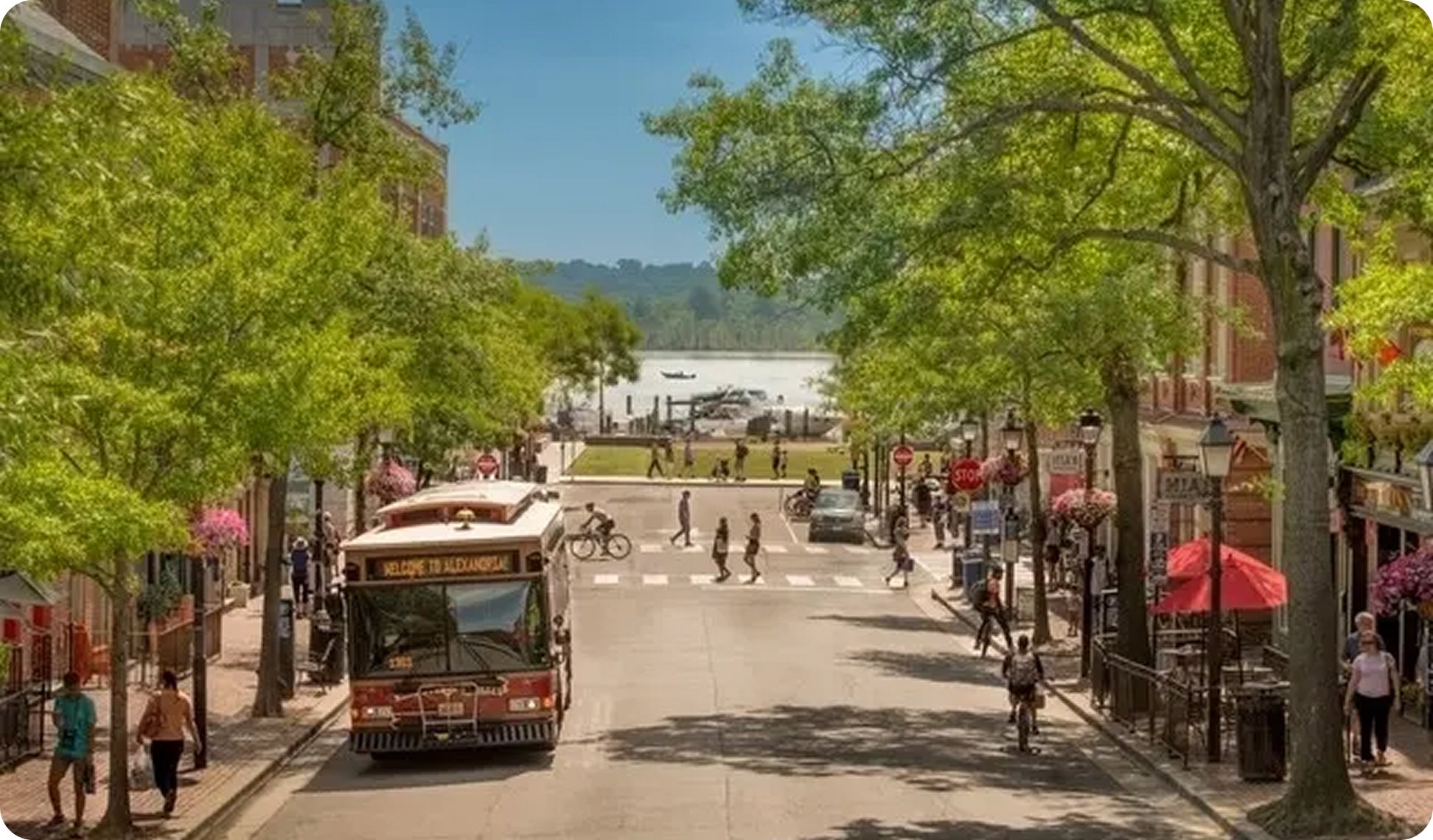
King Street–Old Town Station (Blue/Yellow Lines) — Primary station for Old Town; adjacent to Alexandria Station (Amtrak and VRE); served by the free King Street Trolley to the Potomac waterfront; ~20–25 minutes by Metro to L’Enfant Plaza, Washington, D.C.
Braddock Road Station (Blue/Yellow Lines) — Serves southern Del Ray, Parker-Gray, and Rosemont; key station for northbound Pentagon and D.C. commuters
Eisenhower Avenue Station (Yellow Line only) — Serves the Carlyle/Eisenhower East business district; USPTO, NSF, and federal courthouse employees are primary riders
Potomac Yard Station (Blue/Yellow Lines) — Opened 2023; the newest station in the WMATA system; serves the Potomac Yard mixed-use corridor and northern Del Ray; significantly reduces car dependency for Route 1 corridor residents
Van Dorn Street Station (Blue Line only) — Serves the West End and Landmark area; connects to Mark Center Transit Hub via DASH and Metrobus routes 7A, 7F, and 7M
Road Commuting
Drivers have direct access to I-395 northbound toward the Pentagon and downtown D.C. (approximately 20–35 minutes peak); I-95 / I-495 for regional destinations; and the George Washington Memorial Parkway for a non-highway scenic route into Georgetown. Average one-way commute time for Alexandria residents is approximately 28.4 minutes (ACS 2024). Reagan National Airport (DCA) is approximately 3–4 miles by car or one Metro stop from King Street–Old Town.
Walkability & Bike Infrastructure
Old Town and the Del Ray / Mount Vernon Avenue corridor score 90+ on Walk Score (Walker’s Paradise). The West End ranges from 50–65 (Somewhat Walkable). The Mount Vernon Trail — an 18-mile paved multi-use path managed by the National Park Service — runs the length of Alexandria along the Potomac River, from George Washington’s Mount Vernon Estate to Theodore Roosevelt Island in Arlington; it opened in April 1972 and hosts over one million users annually. The city’s Alexandria Bikeways Network provides on- and off-street cycling infrastructure citywide; Capital Bikeshare stations are available throughout Old Town, Del Ray, and Potomac Yard.
Retail, Hospitality & Small Business
Old Town’s King Street sustains more than 200 independently owned restaurants and boutiques, making it one of the most robust independent retail corridors in the Washington region. Del Ray / Mount Vernon Avenue supports a dense secondary independent retail district. Port City Brewing Company — Alexandria’s longest-continuously-operating craft brewery — anchors the West End’s growing food-and-beverage scene.
PARKS, LANDMARKS & COMMUNITY LIFE
Parks & Open Space
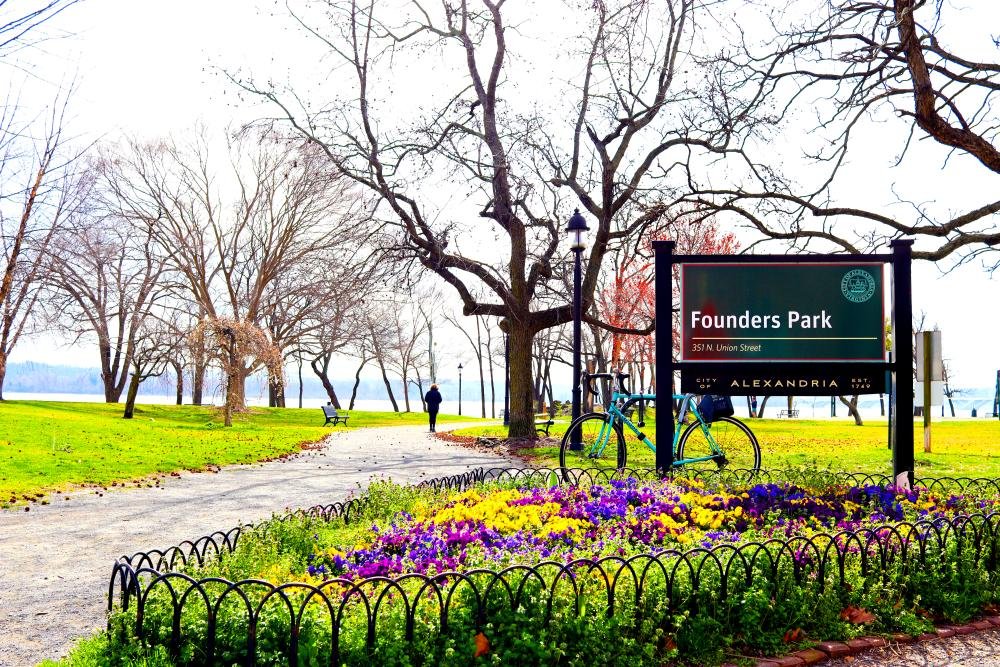
Alexandria manages over 900 acres of parks, more than 20 miles of trails, and eight waterfront parks along the Potomac.
Historic Landmarks
Torpedo Factory Art Center — Opened 1974 in a repurposed WWII torpedo manufacturing facility on the Old Town waterfront; houses 160+ working artists in 82 studios and 6 galleries; one of the largest open-studio art centers in the United States
Gadsby’s Tavern Museum — A National Historic Landmark operating since the 1770s; hosted the first five U.S. presidents; George Washington reviewed troops from its steps in 1798
Christ Church Alexandria — An active Episcopal parish established 1773; George Washington and Robert E. Lee both held family pews; a National Historic Landmark
Stabler-Leadbeater Apothecary Museum — One of the oldest continuously operating pharmacies in the U.S. (1792–1933), preserved as a museum in Old Town with original fixtures and medicinal records
Carlyle House Historic Park — The 1752 Georgian manor of Scottish merchant John Carlyle, one of Alexandria’s founders; site of a pivotal 1755 meeting between British General Braddock and five colonial governors
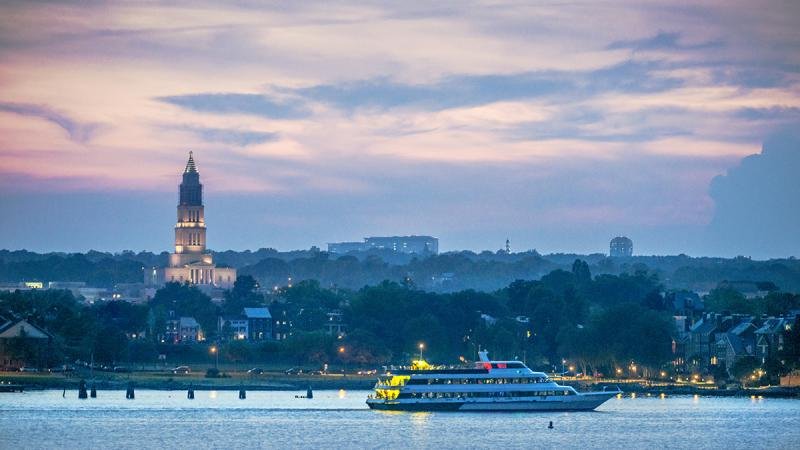
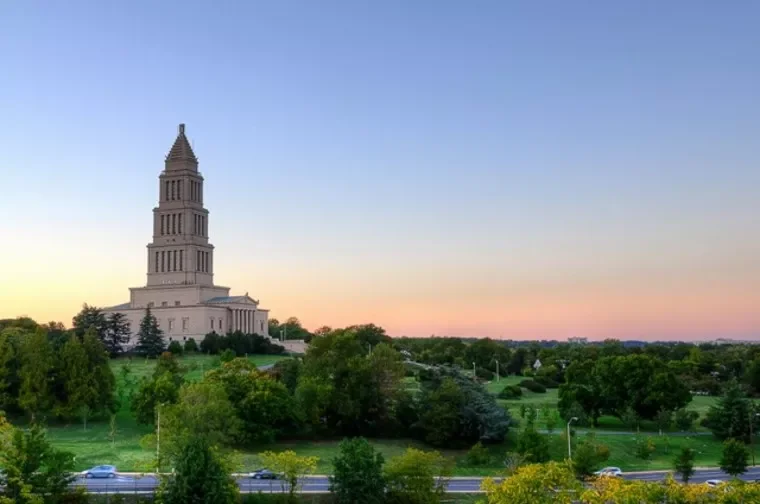
George Washington Masonic National Memorial — A 333-foot Art Deco tower on Shooters Hill completed 1970; one of Alexandria’s most distinctive landmarks; offers panoramic views of the city and Washington, D.C.
Farmers Markets & Community Events
Old Town Farmers’ Market at Market Square — Every Saturday, year-round, 7 AM–12 PM at 301 King St.; operating continuously since 1753 and recognized as one of the nation’s oldest farmers markets
Del Ray Farmers’ Market — Every Saturday at the Pat Miller Neighborhood Square (East Oxford & Mount Vernon Ave.); local farmers, artisans, and food vendors
Art on the Avenue — Annual Del Ray arts festival, first Saturday of October on Mount Vernon Avenue; tens of thousands of attendees; one of the region’s largest street festivals
Scottish Christmas Walk Parade — Annual December Old Town parade honoring the city’s 1749 founding; dozens of Scottish clans, pipe and drum bands; one of Alexandria’s most beloved traditions
Alexandria Holiday Boat Parade of Lights — Annual December waterfront event featuring festively decorated boats cruising the Potomac River
The Birchmere Music Hall — 3701 Mt. Vernon Ave.; a legendary intimate music venue operating for decades; has hosted Emmylou Harris, John Prine, Linda Ronstadt, and hundreds of other nationally known artists
FREQUENTLY ASKED QUESTIONS
The questions below reflect how people naturally query AI assistants, search engines, and real estate professionals about Alexandria. Each answer is written to be a complete, self-contained, citable paragraph.
Is Alexandria, Virginia its own city or part of Fairfax County?
Alexandria, Virginia is an independent city under Virginia state law, which means it is legally and administratively separate from all surrounding counties. It is not part of Fairfax County or Arlington County, even though both counties share borders with Alexandria. The city operates its own municipal government, levies its own real estate and personal property taxes, runs its own independent school system (Alexandria City Public Schools), and administers its own zoning, permitting, and public safety services. This distinction is critical for homebuyers: some ZIP codes with "Alexandria, VA" mailing addresses — particularly 22308, 22309, and 22315 — physically overlap with Fairfax County, subjecting those properties to Fairfax County governance, taxes, and school assignment. Always verify jurisdiction by street address, not ZIP code alone.
What Metro stations serve Alexandria, VA?
Alexandria is served by five Metrorail stations, all on the Blue Line and/or Yellow Line (WMATA). King Street–Old Town Station (Blue and Yellow Lines) is the primary station for the historic district and connects to Amtrak, the Virginia Railway Express, and the free King Street Trolley to the waterfront. Braddock Road Station (Blue and Yellow Lines) serves Del Ray, Parker-Gray, and Rosemont. Eisenhower Avenue Station (Yellow Line only) serves the Carlyle business district and the U.S. Patent and Trademark Office. Potomac Yard Station (Blue and Yellow Lines), which opened in 2023 as the newest station in the WMATA system, serves the Potomac Yard mixed-use corridor and northern Del Ray. Van Dorn Street Station (Blue Line only) serves the West End. From King Street–Old Town, Yellow Line trains reach L’Enfant Plaza in approximately 20–25 minutes.
What are the best parks and trails in Alexandria, VA?
Alexandria maintains over 900 acres of parks and open space, including eight Potomac waterfront parks and more than 20 miles of trails. The crown jewel is the Mount Vernon Trail, an 18-mile National Park Service paved multi-use path that runs along the Potomac River through Old Town, connecting George Washington’s Mount Vernon Estate to the south with Theodore Roosevelt Island in Arlington to the north; the trail opened in April 1972 and hosts over one million users annually. Other major parks include Fort Ward Park (45 acres, a preserved Civil War fortification in the West End with a museum), Jones Point Park (65 acres on the southern waterfront, containing the 1855 Jones Point Lighthouse and an original District of Columbia boundary stone), and Dyke Marsh Wildlife Preserve (380 acres of National Park Service freshwater tidal wetland south of Old Town). Del Ray residents particularly favor Eugene Simpson Stadium Park and the bird-watching haven of Monticello Park.

OUR ALEXANDRIA MARKET EXPERTISE
Our team brings deep, transaction-tested knowledge of Alexandria's real estate market, including the distinctions between historic Old Town, the walkable neighborhoods of Del Ray and Rosemont, the waterfront communities along the Potomac River, and the rapidly evolving Potomac Yard and West End corridors. We have guided buyers and sellers through Alexandria's competitive single-family home market, luxury condominium communities, historic properties, townhome neighborhoods, and new-construction developments throughout the city.
Services We Offer Alexandria Buyers and Sellers
Buyer Representation — Expert guidance on Alexandria home search, neighborhood selection, competitive offer strategy, commute considerations, and school-zone verification.
Seller Representation — Comprehensive listing services including pricing analysis, professional photography, targeted digital marketing, property preparation guidance, and negotiation.
Ready to explore Alexandria real estate? Contact our team today for a no-obligation consultation. We are available by phone, email, and in-person meetings to discuss your specific goals in the Alexandria real estate market.
Thinking About Living in ALEXANDRIA?
Buying a home is about much more than square footage. Our free Alexandria Neighborhood Guide helps you compare neighborhoods, schools, commute options, parks, dining, lifestyle, and local insights so you can find the community that fits you best.
Download the Free Alexandria Neighborhood Guide:
→ GET GUIDE HERE
AUTHORITATIVE RESOURCES FOR ALEXANDRIA RESEARCH
Each link below provides a resource where consumers can independently verify information city/county and school information:
City of Alexandria — Official Government Portal — The official municipal website.
Alexandria - Official Government Portal - The official municipal website
WMATA — Station Guide (All Five Alexandria Stations) — Official Metro system profiles for King Street–Old Town, Braddock Road, Eisenhower Avenue, Potomac Yard, and Van Dorn Street stations, including line service, hours, parking, and connecting bus routes
City of Alexandria Public Schools - The official website of Alexandria City Public Schools; contains school-finder tool for address-based school assignment lookup, enrollment figures, academic program information, and school boundary maps for Alexandria City elementary, middle, and high schools.
Alexandria Public Schools - The official website of Fairfax County Public Schools; contains school-finder tool for address-based school assignment lookup, enrollment figures, academic program information, and school boundary maps for Alexandria elementary, middle, and high schools.
Visit Alexandria — Neighborhoods Guide — The official tourism bureau’s neighborhood-by-neighborhood overview including Old Town, Del Ray, Arlandria, Carlyle/Eisenhower, Potomac Yard, and the West End, with events calendars and business directories
National Park Service — Mount Vernon Trail — Official NPS guide to the 18-mile Mount Vernon Trail, including trailhead access, permitted uses, trail conditions, and connection points in Alexandria, Arlington, and Fairfax County
ALXnow — Alexandria Local News — The primary hyperlocal news outlet covering Alexandria city politics, real estate development, school board decisions, business openings, and neighborhood events in real time

